Large catalogue
Tens of thousands of products, variants, attributes and filters that must stay fast as the catalogue keeps growing.
Magento agency · Magento 2 · Hyvä
In an age of digital commerce and global connectivity, ecommerce platforms play a key role in helping businesses expand their online presence, reach a wider audience and run a successful online business. Magento, one of the leading ecommerce platforms, offers a wealth of features for building powerful online stores. In this guide we take a deep look at Magento ecommerce solutions: their features, advantages and challenges, and how the platform shapes modern ecommerce.
Magento isn't for every online store. It pays off most when sales outgrow what simpler platforms can handle.
Tens of thousands of products, variants, attributes and filters that must stay fast as the catalogue keeps growing.
Customer-group pricing, discounts, credit limits and quick order by SKU for partners, alongside B2C sales in the same system.
Multiple brands, markets, currencies or languages from one admin panel, with a shared catalogue and stock.
ERP, PIM, payment providers, carriers and marketplaces exchanging data automatically, with no retyping.
From the first line of code to maintenance after launch. Hire us for the whole project or just the part you need.
A new custom store: category structure, design, checkout, SEO foundations and all integrations from day one.
Request a quoteMoving from the heavy Luma theme to Hyvä: far less JavaScript, faster pages and better Core Web Vitals on mobile.
What Hyvä bringsA partner portal: per-customer price lists, credit limits, reorders and invoice overview.
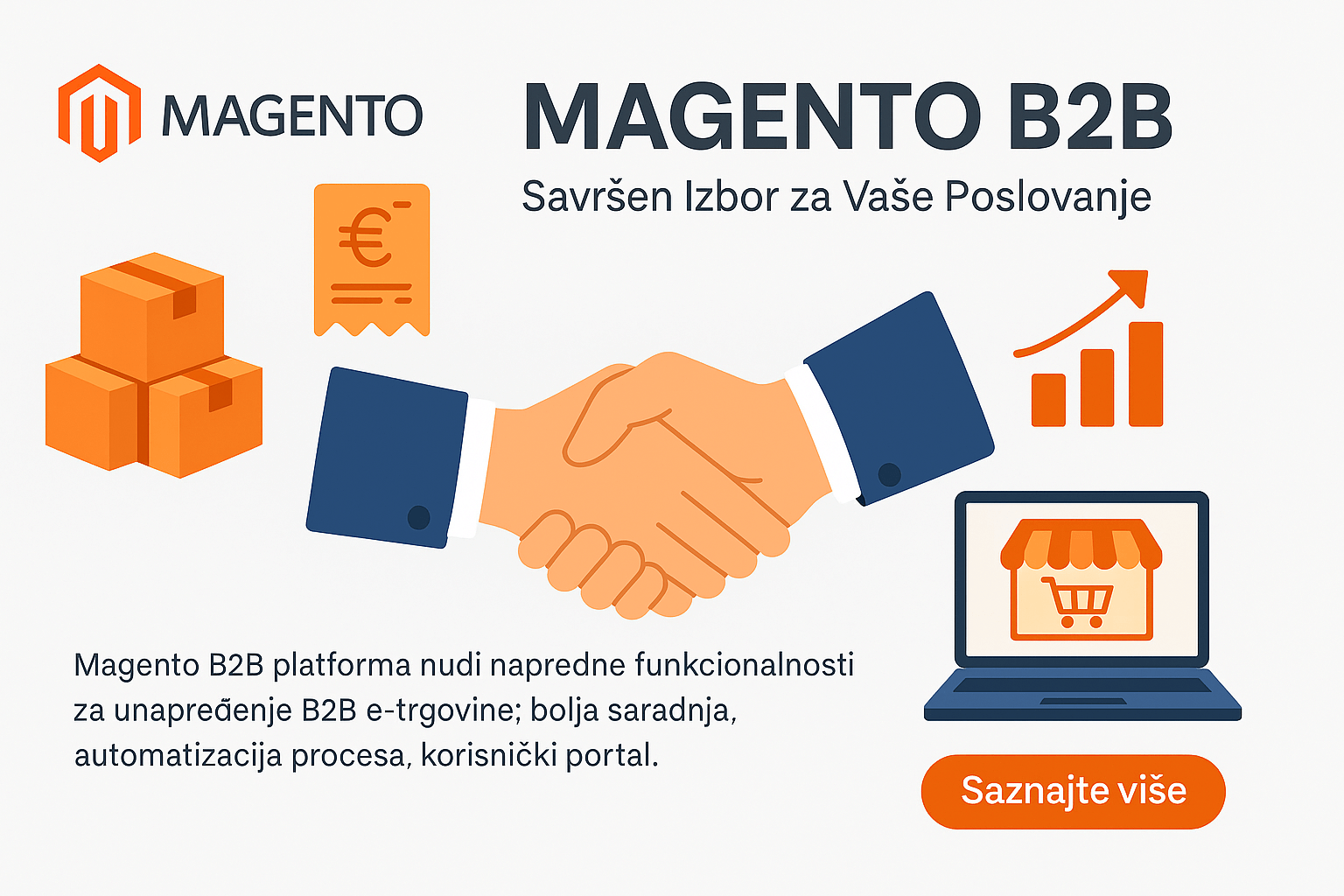
Magento B2BProducts, prices, stock and orders synced with your ERP, card payments via Stripe, Adyen or Mollie, and carrier integrations.
ERP integrationMoving from Magento 1, an older version or another platform, with data transfer and redirects that keep your rankings.
Let's talk about migrationUpdates, security patches, uptime and speed monitoring, and advice on the server Magento really needs.
Magento hostingMagento is one of the most popular open-source ecommerce platforms, enabling businesses to build and run their online stores. Founded in 2007, Magento has become synonymous with flexibility, scalability and advanced features in ecommerce. Its open architecture allows customisation and personalisation, making it suitable for all kinds of businesses, from small start-ups to large corporations.
Key features of the Magento platform include:
Magento brings a number of key advantages to businesses that want to build and grow their online presence:
Despite its many advantages, Magento can also bring challenges:
A slow store loses customers before they see a product. That's why we plan for speed from the start instead of patching it after launch.
Magento is likely to keep playing a key role in ecommerce. Its flexibility and scalability let businesses adapt to changing customer needs and technology. Here are a few likely trends for the platform:
Conclusion
Magento is a powerful tool for businesses that want to compete successfully online. Its flexibility, scalability and rich features let businesses build stores that fit their needs and goals. Whatever challenges arise, Magento keeps shaping modern ecommerce through innovation and constant evolution. With careful implementation, ongoing maintenance and adoption of new technology, businesses can achieve outstanding results with Magento as the foundation of their online presence.
Clear phases, clear deadlines and visible progress from week one.
We learn your range, customers, ERP and processes. You get a specification, phase plan and quote.
Categories, filters, product page and checkout. You approve the design before development.
We build the theme and custom features, with speed and SEO structure from the start.
ERP, payments, carriers and marketing tools, tested on real data.
Data transfer and redirects for old URLs, then a launch without losing rankings.
Updates, monitoring, SEO and new features as the store grows.
Magento Commerce (now part of Adobe Commerce) can be a good long-term solution for building an online store, but it depends on several factors, such as your business's specific needs, the resources available to you and your long-term strategic goals. Here are the key aspects to help you decide whether Magento Commerce is right for you:
Magento Commerce is an extremely powerful platform suited to large, scalable and complex online stores. However, its complexity and implementation and maintenance costs can be a barrier for smaller businesses. If you can invest in infrastructure and technical support and need a high degree of flexibility, Magento can be a very good long-term option. If your needs are simpler, consider platforms that are easier to manage and need fewer technical resources.
Can't find your answer? Write to us and we'll reply within one business day.
The price depends on the number of products, design, integrations and B2B features. After the analysis you get a quote split into phases, so you know exactly what you pay for and when.
For most companies the free Magento Open Source is enough. Adobe Commerce is licensed and has extra features, and pays off for very large, complex systems. We recommend based on your needs.
Hyvä is a modern frontend theme for Magento 2 that loads far less code than the standard Luma theme. The result is faster pages and better Core Web Vitals, especially on mobile.
Yes. We start with a technical audit of the code, extensions, server and speed, then propose what to fix now and what to plan as ongoing maintenance.
Magento needs a VPS or dedicated server with enough memory, caching and search (OpenSearch). We cover this in our guide Magento hosting.
Send a link to your current store or a few sentences about your range and plans. We reply within one business day with a proposed next step.
Magento B2B is an ideal solution for businesses that want to grow in B2B ecommerce. With growing interest in online trade between companies, Magento B2B offers features that help businesses work more efficiently, connect with partners and improve the customer experience. […]
Read moreHyvä is a modern frontend theme for Magento 2, designed to be faster, simpler to use and easier to customise than traditional themes such as Luma. It was created to improve performance and user experience using modern web technologies. […]
Read moreMagento Commerce (formerly Magento 2) is a popular ecommerce platform often used for B2C. To decide whether it's the right base for your B2C store, you should carefully weigh a number of factors.
Read more