SEO audit
A review of indexing, speed, structure, content and links, benchmarked against competitors. You get a priority list, not an 80-page report.
Technical SEO · Content · Links
SEO brings customers from Google search without paying for every click. We fix your site's technical foundations, content and authority, then measure the rankings, traffic and enquiries SEO delivers.
We cover all three sides of SEO: technical foundations, content and authority. Without one of them, the other two deliver far less.
A review of indexing, speed, structure, content and links, benchmarked against competitors. You get a priority list, not an 80-page report.
Sitemap, robots.txt, canonical tags, redirects, speed and Core Web Vitals, mobile rendering and structured data. We make the fixes ourselves, in the code.
Titles, meta descriptions, H1–H3 structure, URLs, alt text and internal links, page by page, based on the keywords that bring customers.
Keyword and search intent research, a topic plan and copy for service, category and blog pages that answers customers' real questions.
Quality backlinks from relevant sites in your target markets, PR placements and brand mentions. No buying link packages that can do harm.
Categories and filters that don't create duplicates, product descriptions, Product schema and Merchant Center. On Magento and WooCommerce stores we also fix what can't be fixed from the outside.
First we remove what holds the site back, then we build what pushes it forward. Every month you know what was done and what it delivered.
An SEO audit of your site and competitors, and agreement on which services or products should drive enquiries.
A list of phrases by search intent, mapped to pages without overlap.
Indexing, speed, duplicates, redirects and structured data.
Titles, descriptions, copy and internal links for priority pages.
Backlinks, brand mentions and Google Business Profile.
Rankings, organic traffic and enquiries from Search Console and Analytics, every month.
Nobody can honestly guarantee first place on Google. What we can guarantee is a clear plan, work delivered and measurement that shows whether SEO is paying off.
The cost of SEO depends on site size, how strong the competition is and how much work the technical side, content and links need. So we start with a free SEO audit and then give an exact quote. Indicative packages:
One-off
from €500
For sites that need a clear picture and a priority list.
Most popular
Monthly
from €600/month
For companies that want steady growth from Google search.
Monthly
from €800/month
For online stores with categories, filters and hundreds of products.
In today's digital world, where search engines are the signposts to information, SEO has become essential to online success. “SEO” stands for search engine optimisation: a set of techniques and strategies used to help websites rank higher in search results.
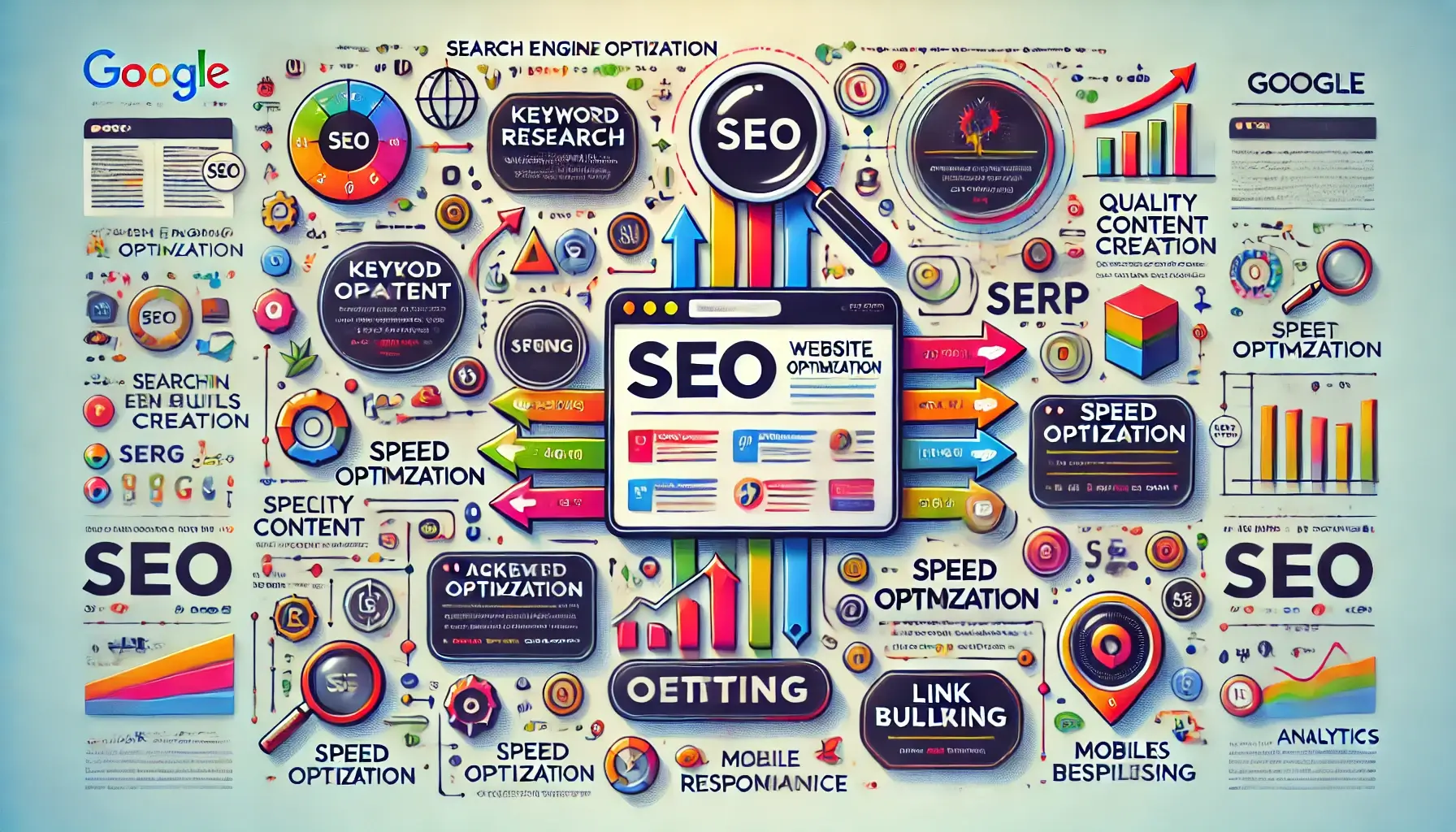
SEO is a set of techniques and strategies used to improve websites for both search engines and users. The goal is to rank higher in search results, which means more visibility, more visits and better results.
The internet has become people's main source of information worldwide. Search engines such as Google and Bing play a key role in how people find information, products and services. Most users rarely look beyond the first page of results, so ranking near the top is essential to attract visitors. Good SEO helps you achieve exactly that.
SEO covers a number of elements that together determine how a site ranks. Here are the key aspects to consider:
Keywords are the terms users type into search engines to find information. Identifying the right keywords for your industry is the foundation of successful SEO.
On-page SEO means optimising elements directly on your site to improve its visibility.
Technical SEO covers the technical aspects of your site that affect its visibility in search engines.
Off-page SEO covers activity outside your site that affects its visibility.
For local businesses, local SEO is key to attracting nearby customers.
Successful SEO takes a holistic approach that combines several strategies:
Quality content is the foundation of SEO. Create content that meets your audience's needs and interests: blog posts, guides, infographics and video.
Technical optimisation keeps your site fast, mobile-friendly and secure. Monitor performance regularly and fix technical issues.
Building quality backlinks can significantly improve your rankings. Aim for links from relevant, authoritative sites.
Social media activity increases the visibility of your content and brand. Share content, talk to followers and grow engagement.
Track site performance regularly with Google Analytics and Google Search Console. Analyse traffic, keywords and conversions to find areas to improve.
While SEO can significantly improve a site's visibility, it comes with challenges:
Search engines regularly update their algorithms to improve user experience and prevent manipulation. What works today may work less well tomorrow.
Competition for keywords can be fierce, making high rankings harder to achieve. Standing out takes time and effort.
The digital landscape changes fast, and SEO trends with it. You have to be ready to adapt to new requirements.
SEO requires continuous monitoring and improvement, which can be demanding for small teams or individuals.
The best SEO tools depend on your needs: keyword research, technical optimisation, competitor tracking or link building. These are the most widely used:
If you're just starting, Google Search Console, PageSpeed Insights and Screaming Frog are a great start. For deeper analysis, Ahrefs, SEMrush and Surfer SEO offer powerful features.
SEO trends for 2026 reflect changes in user behaviour, advances in AI and the growing importance of content quality:
Google AI Overviews, ChatGPT and Gemini answer directly in the results. Classic results get fewer clicks, so content should give clear, short answers AI can cite, with FAQs and tables.
Google increasingly rewards content written by experts, based on real experience and transparent about its author, sources, reviews and contact details.
Speed, responsiveness and visual stability still matter. LCP, INP and CLS should be in the green, especially on mobile.
The focus is on what the user really wants. Topic clusters – linked pages on the same subject – help a site rank for a whole range of related queries.
YouTube and short video appear more and more in results. Transcripts, descriptions and titles help videos get found.
Backlinks still matter, but only from relevant, authoritative sources. Digital PR and brand mentions are gaining importance.
Longer, question-style queries are increasingly common. Content that answers “how”, “how much” and “what is” questions has the edge.
Schema.org markup helps Google and AI systems understand the products, services, company and reviews on your site.
Reviews, consistent business details everywhere and an up-to-date Google profile are key for local search.
AI speeds up research and writing, but copy still needs expert review and editing. Google doesn't penalise AI – it penalises content without value.
SEO is key to greater visibility in search results and attracting the right audience to your site. Through keyword research, content and technical optimisation, quality link building and tracking results, you can achieve better rankings on Google. Remember that SEO is a long-term process that takes patience, constant effort and adaptation.
Can't find your answer? Write to us and we'll reply within one business day.
Technical fixes show results within a few weeks; significant ranking gains usually come after 3 to 6 months, depending on competition and the state of the site. SEO is a process, not a one-off job.
The cost depends on site size, competition and goals. An SEO audit and plan start at €500, and monthly SEO from €600 per month (excl. VAT). You get an exact quote after a free SEO audit, with the work clearly listed. See our packages and prices.
No – and be wary of anyone who does. Google alone decides the order. We guarantee work delivered to plan, honest methods and monthly measurement of results.
Rank and error monitoring, technical maintenance, content optimisation and writing, internal links, link building and a monthly report with recommendations.
Yes, it's our main focus. We sort out categories, filters, product descriptions, Product schema and Google Merchant Center on Magento and WooCommerce stores.
Technical SEO is included in every site we build: speed, URL structure, metadata and structured data. Work on content, links and rankings after launch is a separate service.
Send your site link and the keywords you want to be found for. Within one business day we'll send initial findings and suggested next steps.